The cloth
What the loom remembers
On the patience of warp-dyed silk, and why no two metres are ever the same.
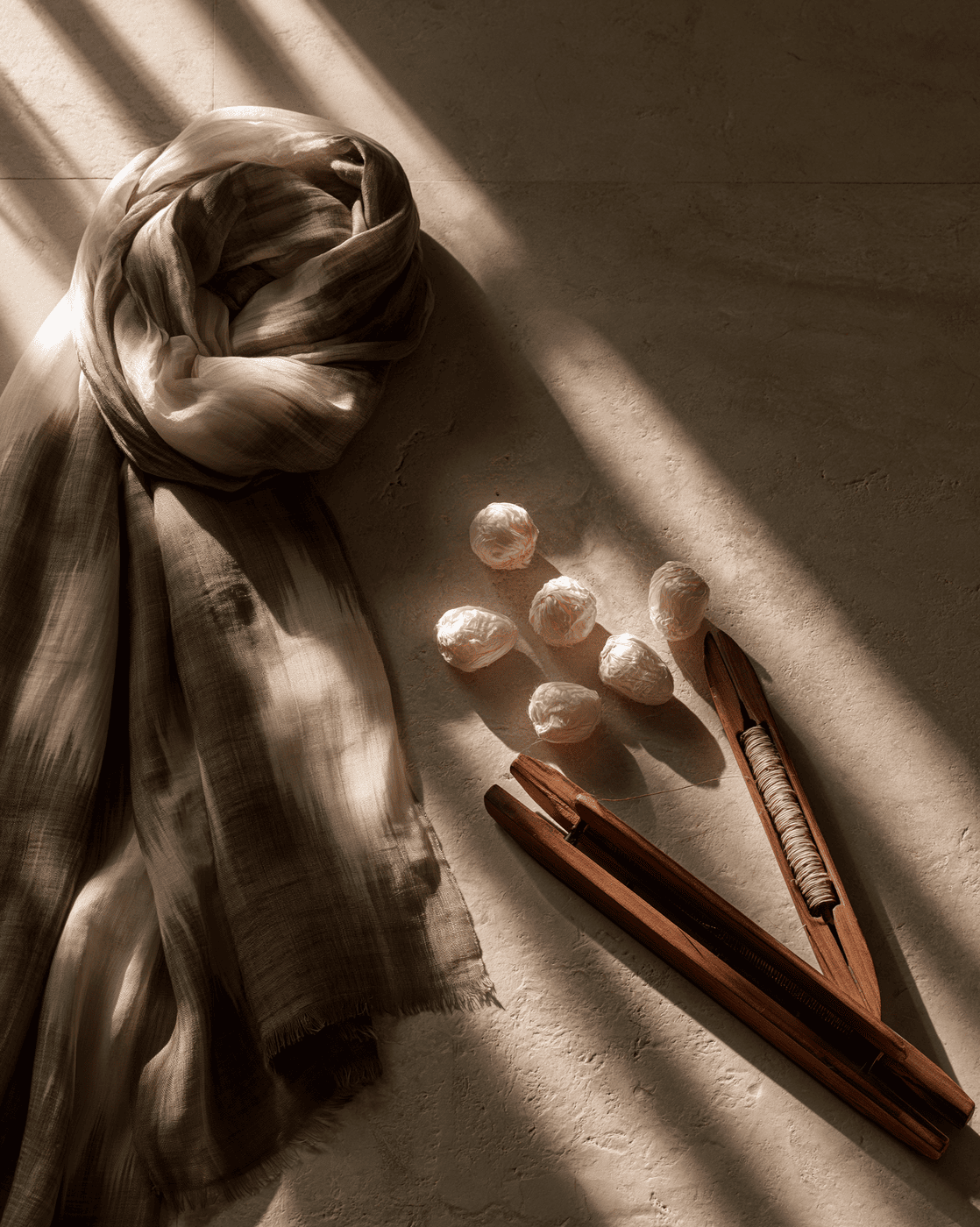
Before a single thread is woven, it is bound and dipped in colour. Indigo for the deep blues, madder root for red, isparak flower for a yellow that warms with age. The dye takes the bound thread only where it is exposed, and so the pattern is written into the silk before the cloth exists at all.
When the weaver finally sets the warp to the loom, the colours meet the weft and bloom at their edges — a soft, clouded line the weavers call abr, the word for cloud. It is the signature of true ikat, and the one thing a machine has never managed to fake. A printed imitation is sharp where it should be soft. The eye knows, even when it cannot say why.
A thread is dyed before it knows what it will become.
Because the dyeing is done by hand and the binding by eye, no two metres leave the loom identical. A house could see this as a flaw to be corrected. We see it as the whole point. A garment cut from such cloth is, by its nature, the only one of itself in the world.
The hands
Forty thousand decisions
A single robe is not made quickly. It is made carefully, by people who have done it their whole lives.
There is a number that gets repeated in the workshops, half proverb and half fact: forty thousand decisions go into a single robe. Where to bind. How long to leave the thread in the dye. Which length of cloth becomes a back panel and which a sleeve, so the clouded pattern falls the way it should across the body.
None of these decisions are made by a machine, and none are made in a hurry. The people who make them learned from people who learned from people, in a line that runs back further than anyone living can remember.
The loom does not hurry, and neither do we.
This is why the Heritage collection is small, and why each piece is numbered. We are not in the business of volume. We are in the business of making something once, well, and letting it last longer than the season it was born in.
The road
A thousand years of looms
The valley did not invent silk. It simply never stopped weaving it.
For more than a millennium, this corner of the old Silk Road has dyed and woven by hand. Caravans came and went; empires rose and were forgotten; and through all of it the looms kept their rhythm. Craft, when it is this old, stops being a technique and becomes a kind of memory held in common.
Ferganali was founded on a simple refusal: not to let that memory become a museum piece. The same hands, the same looms, the same dyes — but cut into clothes made for how people actually live and dress now. Tradition is not a costume to be admired from a distance. It is a working thing, and it works best when it is worn.
— From the founder's notes